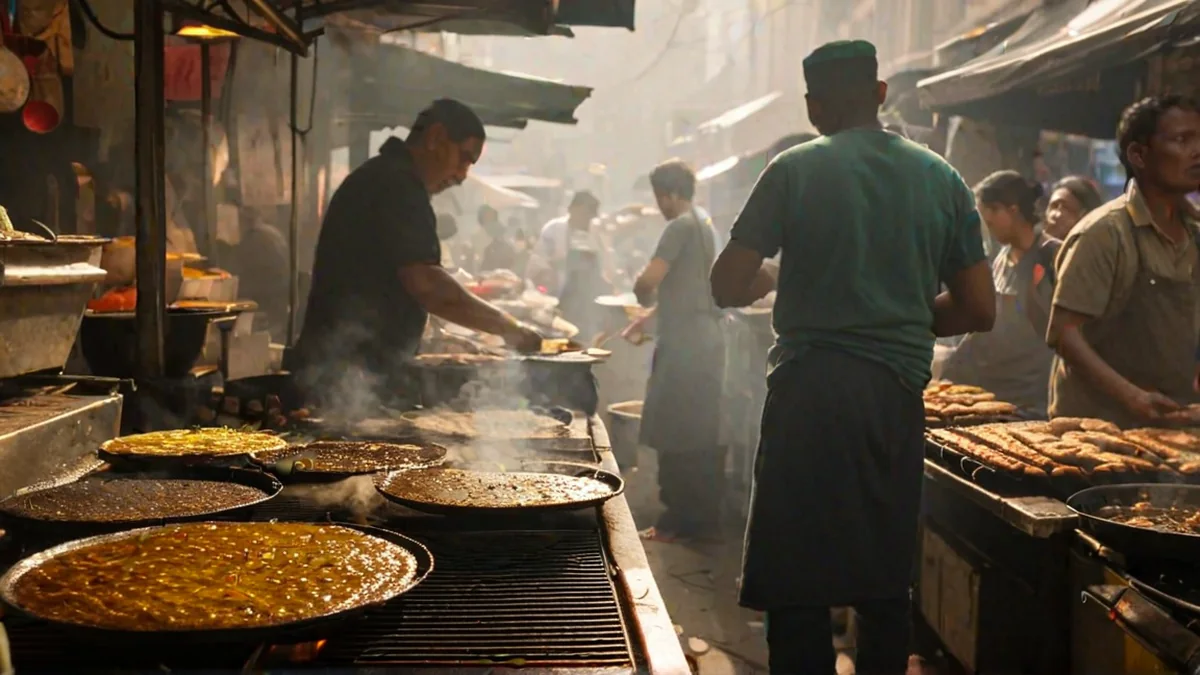
Fire investigation and construction inspection both taught me the same lesson: risk isn't a yes/no question, it's a set of factors you weigh together. Is street food safe to eat is the wrong question, framed that way. The right question is what specific factors at this specific stall tell you about the risk, right now, today.
This isn't a list of rules to follow blindly. It's a risk assessment, the same kind I'd run walking up to any unfamiliar hazard — gather the visible information, weigh it, decide.
Is street food safe to eat? Wrong framing, better question
Fear-based advice says avoid street food entirely and eat only at restaurants with visible health permits. That advice ignores that plenty of restaurants have poor food handling behind a clean-looking dining room, and plenty of street stalls run a tighter operation than they look like they do. The actual signal isn't "street food" versus "restaurant." It's turnover, method, and behaviour, observable in about thirty seconds of watching.
1. Turnover — the single best predictor
A stall selling through its stock fast, with a line of locals, is cycling food quickly enough that nothing sits at unsafe temperatures for long. A stall with food sitting in a display case for hours, with few customers, is the higher-risk one — even if it looks cleaner. Busy is safer than clean-looking-and-empty. This is the single most useful heuristic and it's counterintuitive to most travellers, who instinctively trust the tidy, quiet stall over the chaotic, busy one.
2. Cooked-to-order beats sitting, almost every time
Watch what happens between you ordering and the food reaching you. Food cooked fresh in front of you — grilled, fried, boiled to order — passes through a high-heat kill step right before you eat it. Food that's pre-cooked and sitting, especially anything with rice, meat, or dairy held at room temperature, is the higher-risk category regardless of how the stall looks. This is a bigger factor than the surface cleanliness of the cart.
3. Who's eating there
A stall full of local workers on their lunch break, day after day, is a stall that's passed a very long, very effective ongoing inspection: the people who eat there daily and would stop if it made them sick. A stall targeting tourists exclusively, with photos on a laminated menu and nobody local in line, hasn't earned that same track record.
4. Water and ice — a separate risk category
Water and ice are handled differently from cooked food and deserve their own check:
- Ice made from filtered or treated water in commercial blocks (often uniform cylinders with a hole through the middle) is generally lower risk than ice made and frozen in open trays on-site.
- Bottled or boiled drinks are the safer default in areas where tap water isn't reliably treated.
- Ask if you're unsure — "where's the ice from" is a completely normal question and a stall confident in its sourcing will answer it plainly.
5. Cut fruit — high risk, specific reason
Pre-cut fruit sitting out, especially in heat, is one of the higher-risk street food categories, not because of the fruit itself but because cutting introduces surface bacteria that then sits at room temperature. Fruit you peel yourself, or that's cut to order in front of you, avoids this. Pre-cut fruit sitting in a cart for an unknown number of hours is a different risk category entirely, even from the same vendor.
6. Hand-washing and surface habits
Watch for thirty seconds before ordering. Does the vendor handle raw ingredients and cash with the same hands, without any wash or glove change in between? Is there a visible handwashing setup at all, even a basic one? This is one of the few areas where you can directly observe practice rather than infer it, and it's worth the thirty seconds.
Quick reference: lower risk vs. higher risk
| Factor | Lower risk | Higher risk |
|---|---|---|
| Turnover | Busy, cycling through stock fast | Slow, food sitting for hours |
| Cooking method | Cooked to order in front of you | Pre-cooked, held at room temperature |
| Customer base | Mostly locals, repeat regulars | Tourist-only clientele |
| Ice/water | Commercial block ice, bottled water | Unknown source, tray-frozen ice |
| Fruit | Peeled to order or self-peeled | Pre-cut, sitting exposed |
| Hand hygiene | Visible wash setup, separates cash and food handling | No visible hygiene practice |
What this doesn't mean
This isn't a guarantee system. Even a busy, well-run stall can have an off day, and even careful eaters get sick sometimes — that's travel, not a moral failing on anyone's part. The point of a risk assessment isn't to get to zero risk. It's to stack the odds in your favour with information that's actually available to you, instead of either avoiding an entire category of food out of blanket fear or eating with no judgment at all.
Where this fits into Vastura Travel
Food is one of the areas Vastura Travel will eventually cover for each destination — not restaurant reviews, but the same kind of practical, on-the-ground assessment as the operator checklists. I'll be eating a lot of street food on this trip starting September 2026, and I'll be applying exactly this method, stall by stall, country by country. If something makes me sick despite all of this, I'll say so. That's the deal.