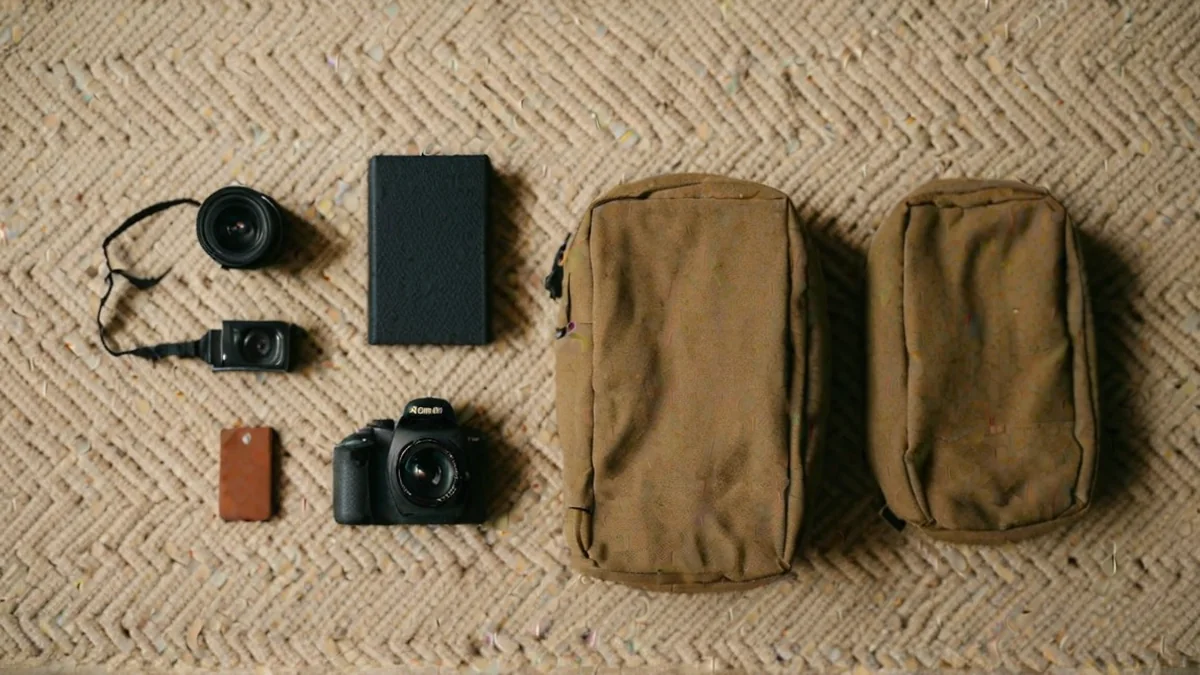
I've spent more time deciding on cameras for this trip than I expected to, mostly because the answer to best camera for travel and diving isn't one camera — it's a small kit that covers reef, market, and road without turning every day into equipment logistics. Here's what I've landed on, and I want to be upfront: this is a plan, not a review. I haven't shot with any of this gear in the field yet. I'll update this once I have real footage from real dives and real border crossings.
Why this isn't a "best camera" ranking in the usual sense
Most gear articles compare cameras against each other in isolation. My problem is different — I need one system that handles reef diving, street and market scenes where a big camera changes how people react to you, and long days on a motorbike or in a truck where gear needs to survive dust, heat, and getting knocked around. That's a kit problem, not a single-camera problem.
The kit
| Camera | Role |
|---|---|
| Insta360 X5 + dive case | 360° capture, reef footage, general action — one body covers three use cases |
| Insta360 GO Ultra | Discreet pendant-style POV camera for markets, streets, casual moments |
| iPhone | Stills, quick video, the camera that's always already in my pocket |
| Drone | Landscape and route context — the wide establishing shots nothing else gets |
Insta360 X5: reef, action, and 360 in one body
The reason the X5 is the core of the kit is that it does three jobs that would otherwise need three separate cameras. With the dive housing, it handles underwater reef footage. Without it, mounted on a chest rig or handlebar, it handles general action footage on the road. And its actual differentiator, 360° capture, means I'm not making a framing decision at the moment I'm shooting — I can pull the frame I want later, in editing, from the full sphere. For someone who's going to be diving, riding, and walking through markets in the same week, not having to carry a different camera for each of those is worth more to me than any single spec.
Why I deliberately skipped a GoPro
This is the choice people ask about most. A GoPro is the default answer to "action camera" for most travelers, and I'm not carrying one. The reason is straightforward: the GO Ultra already covers the discreet, always-rolling POV role a GoPro would typically fill, and the X5 covers the action and reef role a GoPro would also typically fill. Adding a GoPro on top of both wouldn't add a new capability — it would just be a third camera doing a job the other two already do, competing for the same battery charging routine, the same SD card management, the same pack space. On a year-long trip, redundant gear is a cost, not a safety margin. I'd rather carry fewer systems and know each one well than carry overlapping systems and be mediocre with all of them.
The GO Ultra's actual job: staying out of the way
The GO Ultra is small enough to wear as a pendant or clip it somewhere unobtrusive, and that's the entire point of including it. A big camera changes a market stall interaction, changes how a family reacts to you on a bus, changes the moment. A tiny, already-rolling camera doesn't erase that effect, but it reduces it more than anything else in the bag. For documenting the actual texture of a place — not staged shots, just what a market or a border crossing or a bus ride actually looks like — a camera nobody's paying attention to matters more than resolution.
iPhone: the camera that's actually with me
Unglamorous, but true: the best camera is the one in your hand when something happens. The iPhone handles stills and quick clips in the moments when pulling out a dedicated camera would be too slow or too much — a conversation at a food stall, a quick shot from a bus window. It's not trying to replace the other gear. It's covering the gap between "I have a camera ready" and "something's happening right now."
Drone: the wide shot nothing else gets
Route context — the scale of a border crossing, a coastline, a mountain road — is something none of the ground-level or underwater cameras can capture. The drone's job is narrow and specific: establishing shots that show where a place actually sits in its landscape. It's the one piece of the kit I expect to use least often, and that's by design — it's for the handful of shots nothing else in the bag can produce, not for daily use.
What I've deferred, on purpose: a DSLR
I thought seriously about bringing a dedicated DSLR or mirrorless camera for higher-quality stills, and decided against it for this trip. The honest reason is weight, charging logistics, and the fact that a serious camera body draws attention in exactly the situations where the GO Ultra's whole value is staying invisible. I haven't ruled it out permanently — if the trip proves the smaller kit is limiting in a specific, recurring way, that's a decision I can revisit down the line. But starting heavier than necessary, on a trip this long, is a mistake I'd rather not make on day one.
Practical notes for anyone assembling a similar kit
- Red filter for reef diving — water absorbs red light quickly with depth, and footage shot without a red filter tends to skew blue-green and flat. A dive-specific red filter on the X5's housing corrects for this and is a small, cheap addition that makes a real difference in underwater color accuracy.
- Rinse everything in fresh water after salt water — housings, cameras, mounts, all of it. Salt residue left to dry is what kills seals and buttons over months of repeated use, not any single dive.
- Budget real time to learn 360 editing — reframing 360 footage into a normal video isn't intuitive the first time. I've budgeted a couple of hours with the editing software before I leave specifically so I'm not learning it for the first time on the road when I actually need usable footage.
- Battery and card logistics matter more than any single spec — a kit is only as good as your ability to keep it charged and backed up in places with unreliable power, which is most places on this route.
Being honest about what this article is
This is a plan built from research, spec comparisons, and reasoning about what this specific trip actually needs — not a field report. I haven't dived with the X5 housing yet. I haven't tested how the GO Ultra holds up to a full day of heat and dust. Once I have real footage and real failures to report, I'll come back and update this with what actually happened versus what I predicted here.